 FileMakerCoder
The data to answer them is already in your FileMaker system. Getting it out means either building a report for each question or finding the one person who knows how to pull it — and that person is usually busy.
The alternative is to ask in plain language and get an answer back.
What that looks like.
Someone types — or says, whichever's faster in the moment — which customers ordered regularly last year and have gone quiet. A few seconds later, a list. Names, last order date, what they used to spend. No report to build, no request to file, no waiting until Thursday.
Next question: what did we turn away in August because it was already booked. Another list. Nobody built a screen for that question, because nobody knew to ask it until August was over. And someone out in the warehouse with their hands full can ask out loud instead of stopping to type.
| Customer | Last order | Was spending |
|---|---|---|
| Riverside Rentals | Apr 2026 | $3,200 / mo |
| Delta Staging Co. | Mar 2026 | $1,850 / mo |
| Northside Events | Feb 2026 | $1,100 / mo |
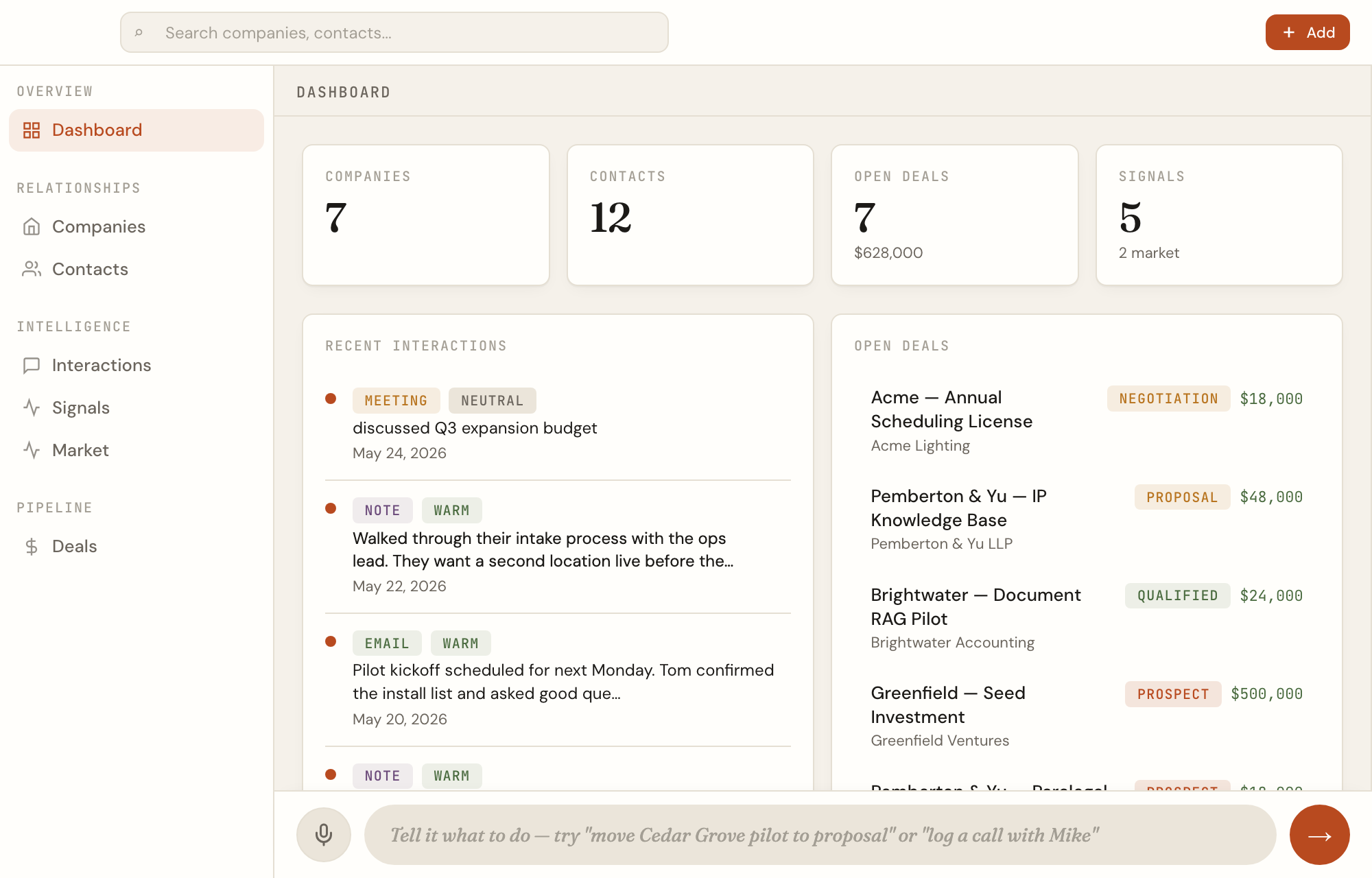
The same ask-it bar runs on other systems I've built. Here it is on a live one — one box at the bottom of the screen, a microphone beside it. Type the question or speak it; the answer comes back against the real data.
Why this is different from a report.
A report answers one question forever. That's fine when the question is stable — invoices, statements, month-end.
But most real questions are one-offs. Someone wonders something in a meeting, and by the time a report exists the moment has passed. So the question goes unanswered, and decisions get made on memory instead. This closes that gap. The cost of asking drops to nearly nothing, so people start asking.
What's underneath.
Where your data goes depends on where the AI model runs, and you choose. On a machine you own, nothing leaves the building. On a cloud model from OpenAI, Anthropic or Google, the question and the records needed to answer it go to that company, and from then on they're out of your hands, whatever its terms say today.
A small piece of software sits between the question and your system. It works out what's being asked, pulls the relevant records, and writes the answer in plain language. Read-only by default — it can tell you anything, and it can't change anything unless you specifically decide otherwise.
Being honest about the limits.
This isn't magic and I won't sell it that way.
It's good at questions that are answerable from your data. It's not good at questions that depend on context nobody ever wrote down — if the reason a customer went quiet lives in someone's memory rather than a field, no system is getting it out.
It can be wrong. Anything working in plain language can misread a question. For anything that matters, it shows you the records behind the answer so you can check.
And it works best on a system that's reasonably clean. If half your key information lives in a notes field, that's worth fixing first — and that's an assessment conversation, not this one.
What it costs.
Setup depends on how much of your system it needs to reach. On a cloud model there's a small per-question cost, billed to your own account at the AI provider's rates. Run the AI on your own hardware instead and there's no per-question cost; the machine is the cost.
Best done after an assessment. This works well on a well-structured system and poorly on a messy one, and it's worth knowing which you have before spending the money.