 FileMakerCoder
Every morning, a short message with what changed since yesterday. Not a status report — a change report. If nothing moved, it says so in one line and you get your morning back.
What it looks like.
A supply company's brief, six a.m. — it opens with the handful of things that actually need a hand today, then one glance at the money:
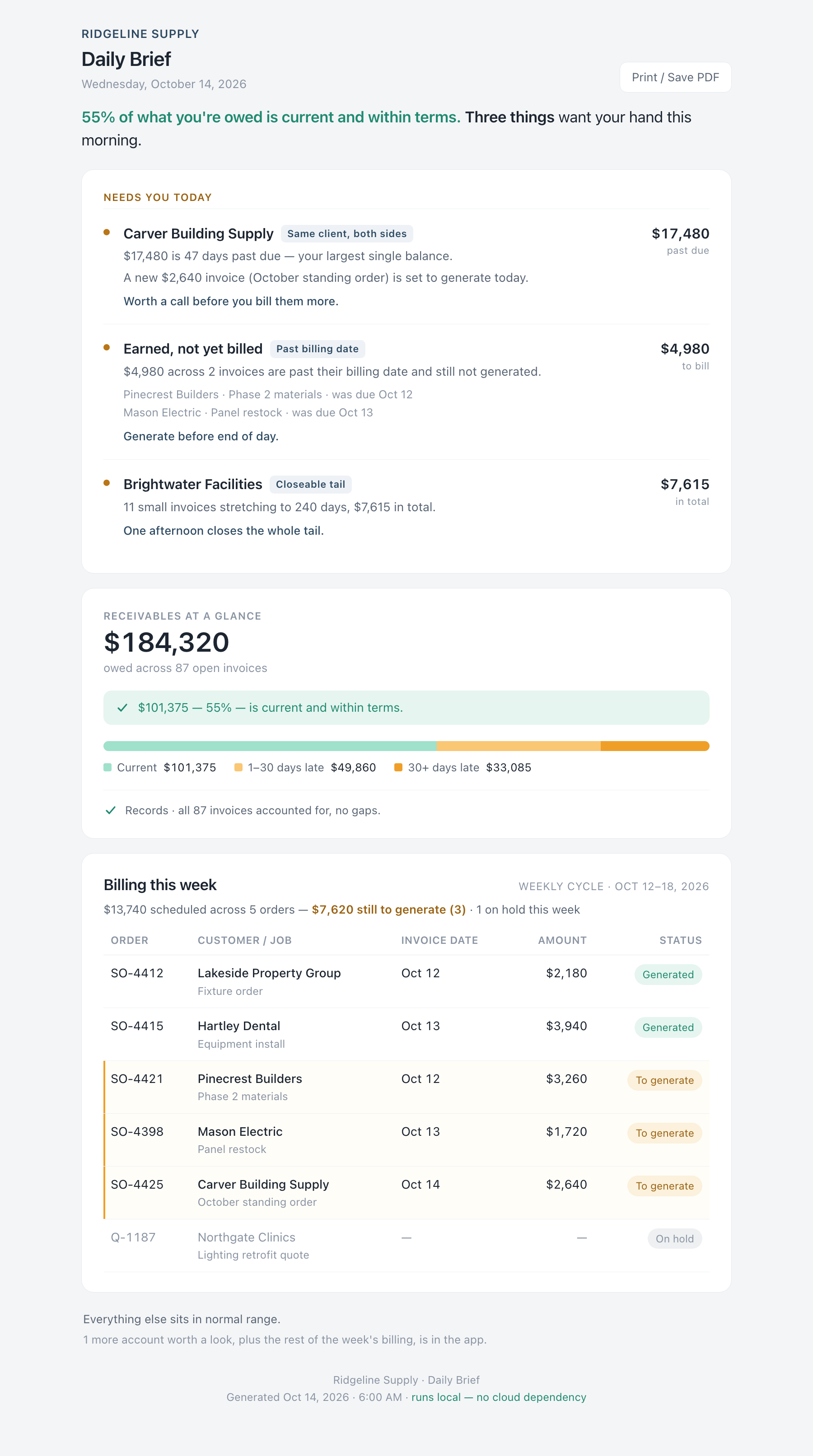
It leads with what moved and what's owed — the overdue balance you're about to invoice again, the work earned but not yet billed, the pile of small invoices you could close out in an afternoon. Everything sitting in normal range is summed in a line, not itemized. No login, nothing to skim.
Why change, not status.
Status reports train you to skim. When ninety percent of the content is the same every day, your eye learns to skip it — and then it skips the one line that wasn't.
A change report has no filler to learn to ignore. Everything in it is there because it moved.
What's underneath.
Your FileMaker system keeps the real records. A scheduled job reads it, compares against yesterday, and writes the differences. The brief arrives by email or text. Nothing new for your staff to log into, nothing to train anyone on.
It's built the same way as the boards on the How it works page: FileMaker sends the data out, and something simple delivers it.
Configuring it for your business.
The metrics aren't generic. A rental company watches how much gear is out earning and what's sitting unused. A service business watches unbilled hours and jobs sitting without a next step. A distributor watches reorder points and aging receivables.
We pick yours together in the assessment. Usually three to five things. If the list runs longer than seven, we've built a status report again and we start over.
What it costs.
The build is priced in the System Assessment's quote. Running it costs effectively nothing — it's a scheduled job and an email.
Stewardship retainer clients get changes to the brief as part of the included monthly hours. What gets watched shifts as the business does.